

category: custom-apps
You have outgrown your off-the-shelf system. The software you chose two years ago worked fine when it was just you and one other person. Now you have a team of eight, new processes, and workflows that no standard platform was designed to handle. You could pay for another subscription, add more plugins, or accept that parts of your business will never quite work the way you need them to.
Or you could build something that does.
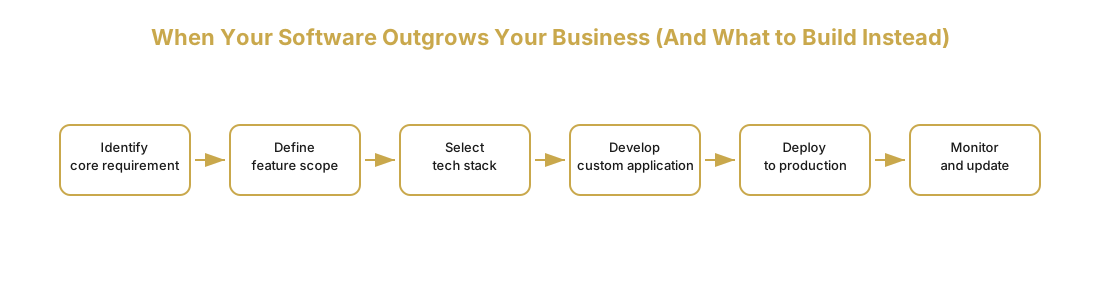
Custom applications are not the expensive, months-long projects they used to be. What has changed is not the technology, it is the approach. Instead of starting from zero, you build using a suite of modules that connect to your existing systems. Fast to deliver. Built to grow with you. Owned by you, not rented from a vendor.
The hidden cost of generic software
Every business is a bit different. Your workflow is not the same as the business down the road, and generic platforms know this. They solve for the 80 per cent, the common case. The remaining 20 per cent is yours to figure out.
This is where the time disappears. Your team workarounds the system. Someone exports data to Excel every Friday afternoon. Someone else re-enters numbers into a second platform because the first one does not integrate with your accounting software. A manager spends an hour every Monday manually checking something that could be automated.
These workarounds are not failures. They are evidence that you have outgrown your current solution. And they cost money, in wasted time, in mistakes, and in the opportunity cost of your team's attention. A team member spending three hours a week on data entry is three hours not spent on work that actually moves the business forward.
Generic software also locks you in. Switching systems is expensive and painful. So you stay, add more subscriptions, accept that parts of your business will never work quite right, and watch the costs climb.
Why custom applications are now the practical choice
Building custom software used to mean hiring a developer, waiting six months, spending five figures, and hoping the result would actually solve your problem. That model still exists, but it is no longer the only option.
Modern custom applications can be built in weeks, not months. They connect to your existing systems, your accounting software, your CRM, your data warehouse. You own the code. You can modify it. You can extend it. And critically, you can move it if you need to.
The architecture is simpler now too. You are not building a monolith. You are building a specific solution that does one thing well: automates your invoicing, manages your reporting, processes your documents, or coordinates your operations. It integrates with the tools you already use and the systems you already trust.
This approach also costs significantly less than it used to. You are paying for the time to build something that solves your actual problem, not for months of discovery on a massive platform. And because the scope is clear, the timeline is predictable.
How to know if custom is right for you
You are ready for a custom application if you recognise any of these situations:
Your team is spending hours every week on manual data entry or repetitive tasks that should be automated. Your existing software does 90 per cent of what you need, but that missing 10 per cent creates constant friction. You have multiple systems that do not talk to each other, and your team manually connects them. You need reports or dashboards that your current platform cannot generate.
None of these situations requires a massive, six-month project. Each can be solved with a focused application that does one job exceptionally well. The result is a tool your team actually wants to use, built around how you actually work.
What to do next
Start by mapping one specific workflow that is causing friction. Not everything, just one. What is the repeated task your team would automate if they could? What data needs to move between systems? What report is taking too long to compile?
That one workflow is your starting point. It is also the best way to understand whether custom is right for you. Contact us for a free discovery call, and we will help you identify where the highest-impact starting point is. We will show you what is possible, what the timeline looks like, and what it actually costs to build something that works for your business.
word count: 742 | category: custom-applications